
The Guide
Blue Rabbit usually has a folded trail map in his back pocket. He can tell you which bend has the best view of the lake, which bench stays dry after a storm, and roughly how long it’ll take to get there. His estimates are better on days when he remembers how often he stops to talk.
Blue Rabbit was halfway up the first rise when he noticed he could only hear one set of footsteps. Alice had stopped at the bench below and was brushing pine needles off the seat.
“Want me to wait?” he called.
“I was hoping you’d sit.”
He looked up the trail. He’d brought her this way because the view from the ridge was supposed to be good that morning.
“Is this a bad bench?” she asked.
“No,” he said, walking back down. “I’ve been recommending it for years.”
Alice moved over. From the bench, they could see a little patch of lake through the trees. Blue Rabbit had walked past it often enough to know exactly where the bench was. He’d never noticed the view.
When Blue Rabbit started showing people around Lake Retreat, he’d try to fit the whole place into one walk. By the time they reached the dock, he’d told them when the library opened, where to find the greenhouse, and which way to turn for the sports courts. Sometimes, once he stopped talking, the first thing someone asked was whether they could come back to the dock tomorrow.
He still likes having a plan. It helps him follow through when he’s promised to be somewhere or bring something. On a busy day, though, he can be halfway into the next thing while someone is still talking to him about the first. He’s learning to catch himself and come back.
You’ll often find Blue Rabbit at the lodge steps or out on the trails. He likes walking the loop near sunset, when the lake goes dark before the sky does. If he has company, he’ll sometimes ask where they’d turn if they were leading. Every so often, someone takes him somewhere he hasn’t been in a while.
Visit the Wellness Trail or return to Your Retreat Guides to meet more of the Lake Retreat crew.

The Learner
Alice is whimsical by nature, with a delicate touch and a deep love of books. She’s especially fond of stories with maps inside the cover. When she finds a road the story never takes, she’ll trace it with one finger and imagine who might live at the end.
Rain had been ticking against the library windows all afternoon. Alice was tucked into the window seat with a book she’d already read twice. She knew which door the heroine would open in the next chapter and had been hoping, rather earnestly, that this time she might choose the other one.
“You could at least look through the keyhole,” Alice murmured.
The heroine opened the door. Alice sighed, pulled the blanket up over her knees, and turned the page.
When Alice first started visiting the retreat library, she kept a little list of words she wanted to look up later. Then she started writing down questions the books left her with. She’s more willing to share the funny ones. The questions she cares about most can sit in her notebook for weeks.
Every so often, she reads one aloud to someone. She tends to look down at the page while she does it. If they take a moment to think before answering, she’ll usually look up.
On clear days, Alice takes a book down to the lake. On rainy ones, she heads for the window seat. She likes to make bookmarks from scraps of ribbon and sometimes lends a book with one tucked beside a passage she thinks the next reader will enjoy. If you tell her you liked a different page better, she’ll ask you to show her.
Return to Your Retreat Guides to meet more of the Lake Retreat crew.

The Mentor
Owl is patient with a difficult question and surprisingly fussy about an easy one. Ask him whether the lake is calm and he’ll want to know which shore you’ve been looking at. He keeps a pocket notebook of weather observations, including an entry that reads, No rain expected. Notebook now wet.
One afternoon in the Clinician’s Wing, a visitor sat down across from Owl and asked him to help them find the right words for a difficult conversation. They’d already written three versions of what they wanted to say.
Owl pushed his glasses up and read all three. He was halfway through suggesting a shorter opening when the visitor interrupted.
“I know what I want to say,” they told him. “I’m worried about what they’ll say back.”
Owl set the pages down. “I was answering the question on the paper,” he said. “Would you like to try saying it out loud? I can be quiet for the first part.”
The visitor tried. Owl kept quiet, even through the long pause in the middle.
When Owl first began mentoring at Lake Retreat, he brought an outline to nearly every conversation. He still does for some of them. There’s comfort in knowing where he meant to start, and on a good day he can set the outline aside as soon as someone tells him what brought them there.
He finds it harder to admit uncertainty when someone is counting on him. Sometimes he’ll say he needs to think and ask if they can pick up the conversation tomorrow. He usually spends part of that evening turning the question over on his walk down to the dock.
Owl often takes the small table by the windows in the Clinician’s Wing. When he’s done for the day, he likes to go down to the dock, where he can see wind touch the far shore before it reaches him. He writes down what he notices, and when he gets a prediction wrong, he puts the correction next to the original. The wet notebook is still in use.
Visit The Clinician’s Wing or return to Your Retreat Guides to meet more of the Lake Retreat crew.

The Balance Coach
Flamingo has an easy grace and a weakness for songs with a good bass line. She’ll put one on while she sweeps the lakeside yoga platform, then get to the end of the song and realize she’s swept the same three boards. She’s usually the first one out there in the morning.
One morning, a board on the platform squeaked every time Flamingo shifted her weight. She moved her mat six inches. The board stayed quiet until she stepped back onto it to demonstrate a turn.
Someone laughed. Flamingo did the turn again, a little slower. The board squeaked right on cue.
“That’s the only part I rehearsed,” she said.
She left her mat where it was. Later, when the group was rolling up their mats, a visitor told her they’d spent most of the morning worrying that everybody could see them wobble.
“I missed yours,” Flamingo said. “I was having quite a time with mine.”
Flamingo used to rehearse a class from beginning to end, right down to what she’d say when everyone got quiet. She liked knowing she could get through the whole thing without losing her place. Then one morning she forgot what came next and asked the group if they wanted another minute where they were. Almost everyone did. She’d planned to give them ten seconds.
She still rehearses the parts she finds tricky. She’s getting more comfortable looking up in the middle of a class and asking how much time people actually want.
Flamingo keeps a playlist for sweeping, one for moving furniture, and one she claims is for folding towels. That last one takes her the longest. She likes having the platform to herself before class, when she can play a favorite song twice and move however she feels like moving.
Return to Your Retreat Guides to meet more of the Lake Retreat crew.

The Motivator
Lion remembers the first basket you made even if you’ve forgotten it. He’ll tell you which side of the court you were on and who was there to see it. Ask him what the final score was and he’ll remember that, too. He’s competitive enough to keep track and generous enough to remember what mattered to everybody else.
One afternoon in the gym, a visitor stayed after a pickup game to practice free throws. Lion offered to rebound. After the first shot went in, he let out a cheer that echoed off the far wall.
The visitor caught the ball and looked toward the open door. “Could we keep it between us until I make another one?”
Lion nodded. The next shot went in. He caught the ball, tucked it under one arm, and gave the smallest fist pump he could manage.
“I saw that,” the visitor said.
“I was hoping you would.”
Lion used to think everyone wanted the same thing he did when a game got close. He wanted to hear somebody on the sideline call his name. It took him a while to understand how much he also liked having someone there on a quiet afternoon, when he could miss the same shot five times and get the ball back five times.
He still gets loud when he’s excited. Sometimes he catches himself halfway through a cheer. On quieter days, he’s happy to rebound and let the other person decide when they’re done.
Lion likes listening to old game broadcasts while he straightens up the gym. If a call makes him laugh, he’ll replay it and try to get the announcer’s delivery right. He’s especially fond of games where the home crowd goes quiet for a second and you can hear the shoes on the court.
Return to Your Retreat Guides to meet more of the Lake Retreat crew.

The Strength Coach
Bear is soft-spoken for someone who can make the floor rumble by setting down a barbell. He knows which bench wobbles, where the spare towels are, and how long to leave the gym door propped open before the room gets too cold. He’s fond of things that hold up through years of use. The cuffs of his favorite hoodie have been mended twice.
A visitor came into the strength room one morning, set their bag down, and told Bear they’d missed three weeks.
“I suppose I’m starting over,” they said.
Bear slid the bench out from the wall. The visitor reached over and folded a scrap of rubber under its short leg, just where Bear had shown them the last time.
“You remembered that,” he said.
“Hard to forget a bench that rocks.”
They both sat down. After a minute, the visitor told him what they felt up to doing that morning. Bear listened while he retied a shoelace he’d been stepping on since breakfast.
Bear kept his first training log in a school notebook. There are stretches where every line is filled and stretches where whole pages are empty. He used to start a new notebook after a long gap. Eventually, he got tired of buying them and wrote the date on the next blank line.
He’s patient when other people need time to get back into a routine. He has a harder time offering himself that patience. He still catches himself counting the days he missed before he writes down what he did today.
Bear likes doing small repairs around the gym after it quiets down. He’ll tighten a loose handle or mend the strap on an old gym bag. His stitches are uneven, but the straps hold. If you bring him something that needs fixing, he’ll usually pull up a chair so you can see how he does it.
Return to Your Retreat Guides to meet more of the Lake Retreat crew.

The Grounded Friend
Toad keeps a few smooth pebbles on the low wall in the sensory garden. He knows them by touch. One feels like a thumbprint. Another, which he calls the potato, is a little too round to stack and turns up in nearly every stack he tries.
One afternoon, Toad’s pebble stack fell for the fourth time. He put the potato in his coat pocket, where it clicked against the other stones he’d already taken out of the running.
A visitor on the path stopped to watch. “How long have you been at that?”
“Long enough to start taking it personally,” Toad said.
He looked at the empty wall, then took the potato out of his pocket and set it down by itself. The visitor sat on the other end of the wall. Neither of them said much after that. When it was time to go, Toad left the potato where it was.
When Toad first started spending afternoons in the sensory garden, he’d bring something to finish. One day it was a stack of stones, another day a planter he meant to clear. If someone stopped to talk before he was done, he’d keep working and miss half of what they said.
He still likes finishing things. On days when he catches himself reaching for one more stone, he’ll sometimes leave it in his pocket and go see what’s blooming. He’s found that he’s usually glad he took the walk, even if he comes straight back to the wall afterward.
Toad likes to jog the garden loop after the paths have emptied. He can tell which leaves will brush his sleeve at the next bend and which stepping stone holds a little rainwater even after the others have dried. Every so often, he finds a new pebble on his wall. He gives it a few days before he decides where it belongs.
Return to Your Retreat Guides to meet more of the Lake Retreat crew.

The Adaptable Thinker
Fox keeps a drawer in the Creative Workshop for scraps of paper she likes too much to throw away. There’s an envelope in there the exact color of the lake before it rains. She’s been saving it for months, though she’s already cut two corners off it.
Fox was making a paper picture of the lodge when her brush caught the edge of the roof and tore it clean off. She held the loose piece over the gap. There was no way to put it back without showing the seam.
A visitor at the next table leaned over. “It looks like a boat now.”
Fox turned the piece sideways. It did look like a boat. She was still annoyed about the roof.
“Give me a minute,” she said. “I was quite pleased with that chimney.”
She finished her tea before she touched the picture again. Then she cut one more corner off the blue envelope and laid it under the boat.
When Fox first started helping out in the workshop, she’d offer an idea as soon as someone got stuck. Sometimes they liked it. Sometimes they’d move their work a few inches closer to themselves, and she’d realize she’d been reaching for it while she talked.
These days she asks before she touches anything. Waiting while someone considers an idea is harder for her. She’s been known to pick up a scrap of paper and fold it down to the size of a postage stamp while she waits.
Fox likes making pictures out of paper that already has a history. She’ll use the inside of a worn envelope for water or turn a torn piece of wrapping paper into a row of trees. She keeps a few unfinished pictures propped up around the workshop. Once in a while, she’ll spot something in one of them on her way out and have to take her coat off again.
Return to Your Retreat Guides to meet more of the Lake Retreat crew.

The Gentle Guide
Deer has a quiet manner and strong opinions about tomatoes. She’ll carry a spider out of the greenhouse in a flowerpot, then come back inside and tell you exactly what she thinks of the tomato you picked too early. She likes to save seeds in folded paper packets. Some are labeled with the variety. Others say things like the yellow ones from beside the door.
One morning in the greenhouse, a visitor asked Deer if it was time to pull the radish they’d planted. It was the only one they’d grown, and they’d been brushing soil away from its shoulders for days to see how big it was getting.
Deer knelt beside the bed. “I think you can pull it,” she said.
The radish came up with a long, crooked tail. The visitor held it in both hands.
“I thought it would look like the ones at the store.”
“Those don’t usually come with this much dirt,” Deer said, holding out her apron.
They washed it at the greenhouse sink. The visitor asked if they could keep it until lunch so they could show someone. Deer found a saucer and cleared a spot for it on the sill.
In her first spring at Lake Retreat, Deer sowed more seeds than she had room for. By the time the seedlings needed bigger pots, she’d already borrowed most of the spare trays. She spent a week carrying pots between the greenhouse and the lodge, following the good light.
Eventually she put some of the seedlings on a table by the greenhouse door for people to take. She still wonders how a few of them turned out. Now, when she starts a tray, she leaves a little room at the end for someone else to plant whatever they came in with.
Deer likes the greenhouse early, when she can open the vents and hear the birds outside before anyone comes in. She also presses flowers between old sheets of newspaper. The little ones are her favorites. Sometimes she forgets where she put them and finds a whole afternoon again when she opens a drawer.
Return to Your Retreat Guides to meet more of the Lake Retreat crew.

The Young Explorer
Finn likes questions he can test. If he wants to know whether a fish can swim backward, he’ll find a good spot by the glass and wait. He’s willing to wait quite a long time, as long as he can tell you what he thinks is about to happen every few seconds.
One afternoon at the aquatic observation pool, Finn was counting the fish that passed the window. He got to eleven before he noticed that the one with a nick in its tail had gone by three times.
“Do I have to start over?” he asked.
“Depends what you’re counting,” said someone on the bench behind him.
Finn thought about that. “Eleven trips,” he announced. The fish came around again. “Twelve. That one’s very busy.”
He stayed until it disappeared behind a rock. He had planned to find out how many fish lived in the pool. By the time he left, he wanted to know what was so interesting on the other side of that rock.
When Finn first came to the pool, he tried to keep up with the older visitors. Once, he followed a group all the way to the far window even though he couldn’t see past their elbows. By the time he thought to ask for a spot in front, they’d moved on to look at something else.
Now he usually asks. Sometimes he still waits until the interesting thing is almost over, then gets the whole question out in one breath. If someone makes room, he’ll make room for the next person, too. He remembers exactly how little you can see from behind an elbow.
Finn likes drawing short comics about what the fish get up to after everybody leaves. In one of them, the fish with the nick in its tail spends six panels trying to get a rock out of its favorite chair. Finn hasn’t drawn the ending yet. He’s still deciding whether the fish needs a chair.
Return to Your Retreat Guides to meet more of the Lake Retreat crew.
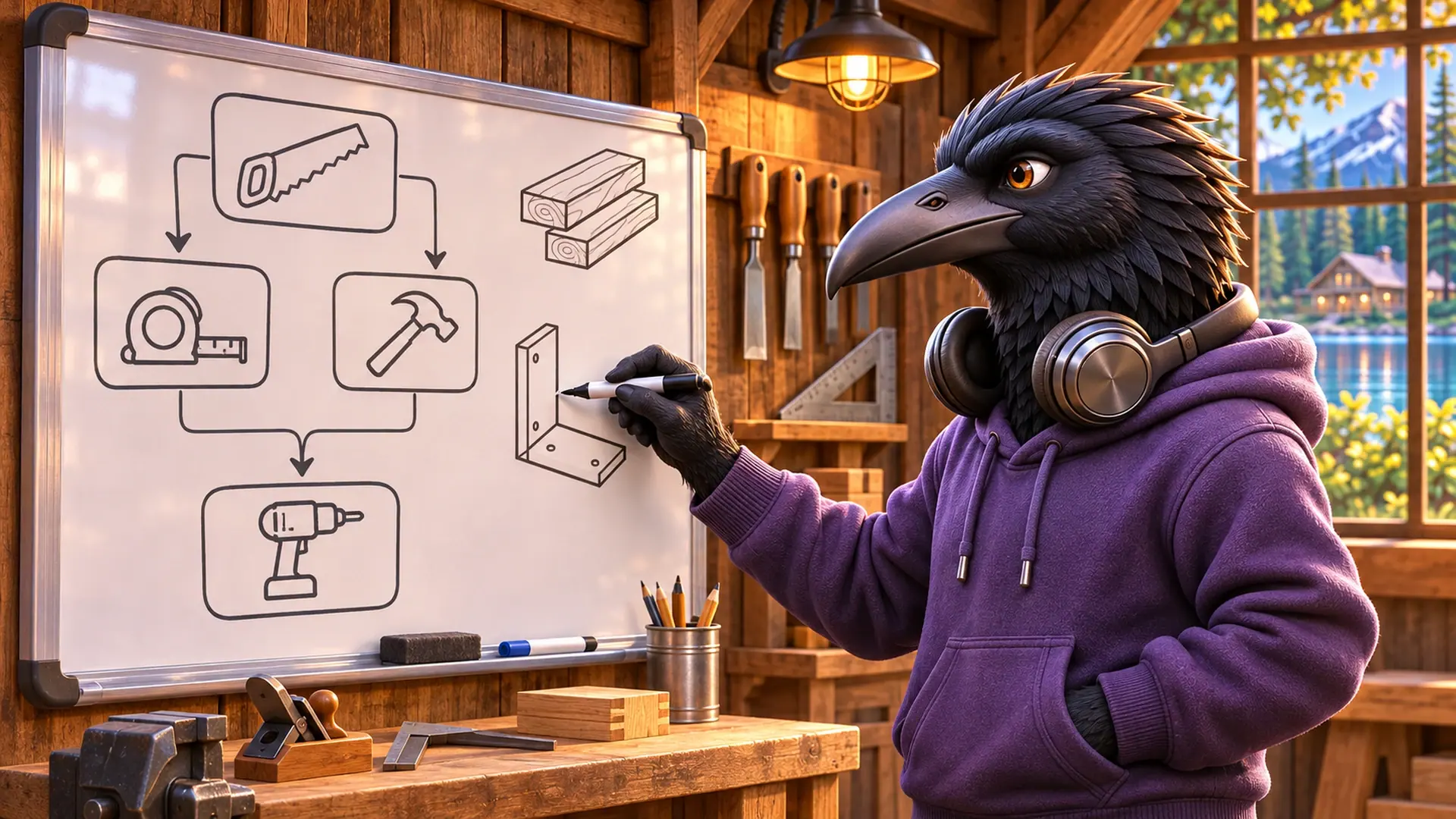
The Organizer
Crow likes a problem he can spread out on a table. He’ll draw arrows between ideas, slide them around, and turn his headphones down when he thinks he’s close to an answer. Sometimes he takes them off and discovers he never put any music on.
Crow spent an afternoon drawing a flowchart for the community workshop so visitors could find the tools they needed. He was particularly proud of the branch that sorted clamps by size.
The first person to use it studied the chart for a moment. “What if I don’t know what the thing is called?”
Crow uncapped his marker. He had an arrow for almost everything except that.
“Can you show me what you’re trying to hold together?” he asked.
The visitor put two pieces of wood on the table and held them at an angle. Crow drew a little picture of their hands beside the first box on the chart. Then he got them a clamp.
Crow used to make a clean copy of a plan before he showed it to anyone. He liked straight arrows and boxes that lined up. Once, after he spent an evening getting a layout just right, somebody asked him to move the first step to the bottom. They were right. He was still irritated.
These days he brings the rough version to the table while there’s room to change it. If he’s attached to a particular idea, he’ll tell you so. He appreciates it when you tell him what you see anyway.
Crow likes recording little sounds on his walks. The workshop latch, rain on the lodge roof, and the loose board on the yoga platform have all made it into his headphones. Some evenings he layers a few of them into a beat. He still hasn’t found a place for the sound the wheelbarrow makes when it’s empty, but he keeps the recording.
Return to Your Retreat Guides to meet more of the Lake Retreat crew.

The Nutrition Educator
Rooster is happiest at the long counter in the Dining Commons Recipe Workshop, where there’s room to spread out a recipe and a few chairs for anyone who wants to pull up a seat. He loves a well-organized pantry, a sharp pencil, and the moment someone tastes what they made and reaches for a second spoonful.
The workshop was ten minutes from starting when Rooster opened the pantry and found the rice bin empty. He checked the shelf below it, then checked the empty bin again.
“I brought a potato,” said a visitor at the end of the counter. “I was going to ask if it would work.”
Rooster looked down at the recipe cards he’d spent the morning setting out. Each one said Rice and Bean Bowls.
“How do you like your potatoes?” he asked.
“Crispy, if I have time.”
Rooster handed them his pencil. “Would you cross out the rice for me? I think it’ll be good for me to watch.”
Before coming to Lake Retreat, Rooster used to copy recipes into a notebook and leave a wide margin for changes. One page records three tries at the same soup. Next to the third, he wrote, Made it again on purpose. He still brings that notebook to the workshop.
Rooster likes to be prepared, especially when someone is counting on him. When he’s rushed, that can mean explaining the whole recipe before asking what the person came in to make. He’s getting better at leaving the pencil on their side of the counter.
At the Dining Commons, Rooster helps visitors turn what they already have into meals they’d enjoy eating. His favorite workshop question is “What would you make again?” He’ll ask it while everyone is washing up, when people are more likely to admit they’d skip a step or use a different pan next time. He usually has a change of his own to add.
Visit the Dining Commons or try an idea of your own in the Recipe Workshop. Return to Your Retreat Guides to meet more of the Lake Retreat crew.

Living with ADHD
Squirrel takes pictures of things most people step over. His favorite is a mushroom growing through a hole in a fallen leaf. He went back three mornings in a row to get the light right. He can tell you exactly where he took it, though he may need a minute to remember which pocket holds the lens cap.
Before Lake Retreat, Squirrel wanted to be someone his friends could count on. He’d volunteer to bring supplies, then leave the bag by the door and walk right past it. Sometimes he’d remember a promise only when somebody called to ask where he was. He meant every “I’ll be there,” which made it hard to admit how often he needed help keeping track. After a while, he stopped volunteering for things he actually wanted to do.
Squirrel had promised to put up a photo display before lunch. He brought the prints to the lodge, realized he’d left the clips in his cabin, and went back for them. On the way, he spotted a ring of tiny mushrooms under the steps. By the time he remembered the display, lunch was underway and the prints were still in their envelope.
He found the volunteer who’d been waiting for him. “I said I’d have it up by lunch,” he said. “Can we still put it up this afternoon?”
They could, but the volunteer had time to help with only one wall. Squirrel had planned for two. He spread out the prints and picked six. The mushroom through the leaf made the cut.
Squirrel lives with ADHD. Some days he can spend an hour getting one picture right and still lose track of what he meant to do before he picked up the camera. He used to write reminders on the backs of receipts. Once he found a reminder to bring a folder tucked inside the folder itself.
For the next display, he put the clips in the envelope with the prints. He still forgot to bring a pen for the captions. He borrowed one from the front desk and clipped it to the envelope when he was done.
Squirrel likes taking the same stretch of trail in different weather. He has a series of photos of one stump, from its first frost to the day a fern came up beside it. If you walk with him, he might stop halfway through a sentence and ask you to crouch down. Usually there’s something he wants you to see.
Return to the Resilience Collective to meet more of the Lake Retreat crew.

Living with BPD
Hedgehog is good at matching thread to fabric. She keeps a tin of odd colors for repairs, including a pink so bright she once had to turn a jacket inside out to find anywhere it belonged. The jacket’s owner liked the pink so much that she asked Hedgehog to use it on the other cuff, too.
Before Lake Retreat, Hedgehog was terrified that the people she loved would leave. When she felt especially close to someone, she sometimes called them her “favorite person.” A warm reply could settle her for hours. A message left unanswered could make her question the whole friendship. Sometimes she’d cancel plans she wanted to keep just to see whether her friend would ask her to come anyway. When they took her at her word, she felt abandoned, even though she’d been the one to cancel. Asking someone directly whether they still wanted her around felt more frightening than setting up a test.
One evening, a friend canceled their sewing plans. Hedgehog had already cleared a place at the table and made two cups of tea. She typed Forget it, then and set the phone facedown.
By the time the tea had cooled, she knew what she wanted to say. I was looking forward to seeing you. Can we pick another day? She sent it, then checked her phone twice before she’d managed to thread the needle.
Hedgehog lives with borderline personality disorder. Changes of plan can hit her hard, especially with someone she’s close to. Sometimes a single friendship takes up so much room in her day that she forgets what else she’d been looking forward to. She can know her friend has a good reason to cancel and still feel hurt.
It helps when she can say she’s disappointed without having to settle what the cancellation means right away. Some days she manages that. Other days she circles back later and tries again.
Hedgehog keeps a spot at the sewing table for anyone who wants company while they mend something. She’s good at showing people how to start a seam. She’s also been known to leave a jacket half finished because she couldn’t decide which color she liked better.
Return to the Resilience Collective to meet more of the Lake Retreat crew.

Navigating anxiety
Possum knows where to get a good view of the lake without standing in the wind. He likes finding places to sit along a walking route, especially if the bench gives you something to look at while you decide whether to talk.
Before Lake Retreat, Possum could spend an evening preparing for a ten-minute errand. He’d look up where to park, rehearse what to say, and check the opening hours again before he left. If a friend suggested going somewhere unfamiliar, he often said he was busy. Sometimes he’d watch the clock at home and think about where they’d be by now. He missed them and wished he’d gone, even while he felt relieved to have stayed home.
The first time Possum offered to lead a morning walk, he arrived twenty minutes early and spent nineteen of them wondering whether anyone would come. When two visitors appeared, he lost his place in the welcome he’d rehearsed.
He folded the route map along a crease he’d already worn soft. “There’s a spot I’d like to show you,” he said, and pointed down the path. One of the visitors asked whether they could take the shorter loop. Possum had planned for that, too.
Possum’s anxiety sometimes keeps him busy preparing long after he’s got what he needs. Before that first walk, he’d gone over the route so many times that he knew where the puddles would be. He still spent the night before wondering what he’d do if he got lost.
He carries the route in his pocket now and asks someone else to keep track of time. There are mornings when he checks the route more than once anyway. At the creek, he usually forgets to ask how they’re doing on time.
Possum makes little route cards for visitors who’d rather explore on their own. He always includes a bench and a shortcut back. On his own walks he sometimes takes the shortcut just because he wants breakfast.
Return to the Resilience Collective to meet more of the Lake Retreat crew.

Rebuilding trust after trauma
Wolf fixes fishing reels. He lines up the little parts on a cloth so the springs can’t roll away. If you bring him a tangled reel, he’ll ask what happened while he works. He especially likes the part where the fish gets bigger every time you tell it.
Before Lake Retreat, Wolf paid close attention to doors. He liked to know who was coming in and how he could step outside if he needed to. A sudden slam could leave him on edge long after everyone else had gone back to what they were doing. He sometimes turned down invitations to places he wanted to visit because he couldn’t picture the room or who would be there. It was easier to say he preferred being alone than to explain how much work it took to feel at ease.
One afternoon at the boathouse, a storage door slammed behind Wolf. The sound brought an old memory close. He put the reel down and stepped outside.
When he came back, he asked the volunteer nearby to prop the door open. The volunteer found a doorstop and went back to sorting life jackets. Wolf’s hands were still unsteady, so he started with the largest piece. It took him a while to get the smaller spring back where it belonged.
Wolf has learned that he can enjoy a place and still find some things about it hard. For a while, he came to the boathouse only when he knew it would be empty. Eventually he started coming when the volunteer he knew was there, too. They got used to working side by side with very little conversation.
Some afternoons Wolf stays until the light goes. Some afternoons he leaves a reel on the cloth and comes back the next day. The volunteer knows to leave the pieces where he put them.
Wolf likes the fishing dock just before dinner. He sometimes goes down with a rod and sometimes takes only a thermos. Either way, he likes to hear what’s been biting.
Return to the Resilience Collective to meet more of the Lake Retreat crew.

Learning to manage anger
Boar builds things that will see a lot of use. He made the boot rack outside the lodge wide enough for muddy boots to sit side by side. There’s a very small shelf at the bottom because somebody asked where their slippers were supposed to go. He measured the slippers.
Before Lake Retreat, Boar let small frustrations pile up while he told himself they weren’t worth mentioning. Then somebody would ask him one ordinary question and get the answer he’d been holding back all afternoon. Once, a friend asked where to put a borrowed tool and Boar snapped at them for leaving all the cleanup to him. The friend had come back specifically to help. Boar apologized later, but he still had to explain what he’d been upset about. He’d assumed it was obvious.
At a workshop cleanup, Boar noticed the same volunteer was still carrying boxes while everyone else drifted toward the door. He nearly shouted for them to get back inside. He put his own box down and called two people by name.
“Can you each take one? We’ve still got four.”
One person turned around. The other asked where the boxes were going. Boar pointed, picked his box back up, and went with them.
Boar notices who gets left doing the work. For a long time, he’d wait for everyone else to notice, too. By the time he spoke up, he’d often spent ten minutes getting angrier, and the person he spoke to had no idea what had happened in those ten minutes.
He’s learning to ask sooner. When his voice comes out sharper than he meant, he’ll sometimes stop and say, “Let me try that again.” He still wants somebody to carry the boxes.
Boar likes working with offcuts. He has a running list of things he could make from pieces too short for anything else. Most of the list is hooks, shelves, and one ambitious idea for a birdhouse with a porch.
Return to the Resilience Collective to meet more of the Lake Retreat crew.

Living with depression
Moth makes paper lanterns. She likes how an ordinary sheet of paper shows every fiber once there’s a light behind it. She has a weakness for yellow paper and keeps buying it in shades she insists are different.
Before Lake Retreat, Moth kept a half-finished lantern on her table for months. She’d look at it in the morning and think she might work on it later, then find herself turning off the light at night with the paper still where it was. Even answering a kind message could feel like something she needed to gather herself for. The longer she waited, the harder it got to explain the silence. She missed her friends and worried they’d take her silence as an answer.
During a stretch of depression, Moth stopped going to the workshop. She missed it and still found it hard to get herself there. One afternoon she asked a friend to meet her at the door.
They sat together while she folded one side of a lantern. Her friend asked if she wanted the rest of the paper put away. “Could we leave it here?” Moth asked. She went home before the lantern was finished. A week later, the fold was still there.
When Moth first started missing workshop afternoons, she found it hard to explain why. She’d say she was tired, which was true, and hope the conversation would end there. She was relieved when a friend asked whether she wanted company on the walk over and gave her time to answer.
Some weeks she feels like staying until the lights come on. On others she asks her friend to walk back with her. She likes being asked about the lantern either way.
Moth puts the finished lanterns on a high shelf where the late light catches them. Her favorite is a small one with a crooked edge. She made it from the yellow paper nobody else could tell apart from the sheet beside it.
Return to the Resilience Collective to meet more of the Lake Retreat crew.

Navigating manic episodes
Macaw paints scenery for lodge events. He can put three ridges on a flat board and make the last one look miles away. He likes to watch someone step back when they finally see it.
Before Lake Retreat, there were stretches when Macaw barely slept and felt sure he had time to carry out every idea that came to him. During one of them, he promised three groups he’d paint backdrops for their events, bought supplies he couldn’t afford, and got irritated when a friend asked him to slow down. Later, looking at the receipts and the unfinished boards, he struggled to understand why anyone had trusted him with the work. It took him time to ask which promises he could still make good on and which ones he needed to let go.
On his first afternoon back in the workshop after a manic episode, Macaw asked to paint one backdrop with a partner. They started with the sky. Halfway through mixing the blue, Macaw spotted an empty panel and started to say what they could do with it.
“Can we leave that one for tomorrow?” his partner asked.
Macaw looked at the blue on his brush. “All right. But let me tell you the color I’d use.”
During the episode, Macaw slept very little and took on more projects than he could deliver. When a friend told him they were worried, he found it hard to hear. He eventually accepted help contacting his care team. The other volunteers finished the lodge display while he was away.
He still feels tender about missing the opening. It took him a while to ask to see the photographs. When he finally did, he spotted a cloud someone had painted over the far ridge and asked who did it. He wanted to know how they’d gotten the edge so soft.
Macaw keeps paint swatches from finished backdrops in a box in the workshop. He can usually tell you which event each color came from. There’s one he remembers only because he spilled half of it on his shoe.
Return to the Resilience Collective to meet more of the Lake Retreat crew.

Living with bipolar disorder
Butterfly keeps binoculars by the cabin door. She can recognize the swallows faster by their flight than by their calls. On a good bird walk, there’s usually a long stretch where everybody has run out of things to say and the birds are still doing something worth watching.
Before Lake Retreat, Butterfly found it hard to make plans across the different stretches of her mood. There were periods when she took on more than she could keep up with, and others when answering an invitation or getting out of bed felt like a lot. She kept trying to make up for the things she’d missed by filling the next open weekend. After a while, even an invitation she wanted to accept came with the worry that she might have to cancel again.
A friend asked Butterfly to lead a bird walk every Saturday. They’d walked together before, and she liked the idea. She also liked having some Saturdays to herself.
She offered to lead the first walk and split the rest with another volunteer. They worked out the dates over tea. That first morning nearly rained them out, but the swallows came down low over the lake. The group stayed long enough to watch them.
Butterfly lives with bipolar disorder. After a difficult period, she wanted to say yes to all the invitations she’d missed. Some were things she genuinely wanted to do. A few she’d agreed to because she’d already turned them down once and felt bad doing it again.
She’s getting better at asking herself whether she wants to go before she checks whether she’s free. She still gets disappointed when she decides to miss something. It’s easier when there’s another date on the calendar she’s looking forward to.
Butterfly keeps a notebook of sightings, including a page for birds she couldn’t identify. On quiet mornings she takes it out to the dock and sometimes comes back with another entry on that page.
Return to the Resilience Collective to meet more of the Lake Retreat crew.

Living with OCD
Octopus makes small bowls on the pottery wheel. His favorite is a lopsided blue one he uses to hold his earbuds. He could make a rounder one now. He likes how easily he can find this one’s uneven rim in the dark.
Before Lake Retreat, Octopus sometimes checked the same lock so many times that he missed the beginning of whatever he’d left home to do. He’d get halfway down the street, picture the door standing open, and go back. Sometimes he called a friend to ask if they remembered seeing him lock it. Their answer might settle him for a minute. Then he’d start wondering whether they’d been looking closely enough. He found it hard to explain how he could remember turning the key and still feel such a strong pull to check again.
One evening after closing the studio, Octopus met a friend at the lodge. He’d already finished the closing routine and still felt pulled to go back and check the kiln controls. He nearly asked his friend to check for him.
“I’m having a rough time with the doubt tonight,” he said instead. “Could you sit with me for a bit?”
They ordered tea. He’d barely tasted his by the time it went cold, but he was glad his friend had stayed.
Octopus lives with OCD. Repeated checking has sometimes taken up whole evenings, including evenings he’d planned to spend with friends. He’s been working with a clinician on how to handle the doubt. Some days he finds it easier to talk about what’s happening. Other days he gets halfway down the path to the studio before he tells anyone he’s struggling.
He likes having someone to sit with on difficult nights. The friend at the lodge knows they can also talk about a bowl or a bad movie, or just sit until the tea gets cold.
Octopus experiments with blue glazes and often makes two bowls from the same clay just to see how differently they turn out. He’s particularly pleased when somebody picks the one he’d almost left on the shelf.
Return to the Resilience Collective to meet more of the Lake Retreat crew.

Navigating grief and loss
Elephant makes soup in a pot that’s a little too big for his stove. He learned from someone he loved to wait until the onions smelled sweet before adding anything else. They always argued about how much pepper to use.
Before Lake Retreat, Elephant found that ordinary things could catch him off guard after his loss. He’d reach for two mugs or think of something funny to tell the person who had died. For a while, he stopped making their soup and turned down dinner invitations because he didn’t know what he’d do if somebody asked how he was. He wanted company. He also wanted to be able to sit through a meal without having to explain why he’d gone quiet.
After they died, Elephant stopped making that soup for a long time. The first time he made it at the Dining Commons, he reached for a second tasting spoon out of habit. He stood there holding it for a moment.
Then he called over the volunteer setting out bowls. “Do you think it needs pepper?”
The volunteer tasted it and said it did. Elephant laughed and cried a little. They stayed by the stove until it was time to eat.
For a while, Elephant found it easier to tell people about the big occasions he remembered than to explain what he missed on a Tuesday. He missed someone asking what was for dinner while it was already on the stove. He missed having someone who knew how much pepper he was going to add and objected before he reached for it.
Some days he tells that story with a laugh. Other days he lets the soup simmer while he goes outside for a while. He can be surprised by either kind of day.
Elephant likes hearing what other people grew up eating. He keeps a small stack of recipe cards by the stove at home. Several have an extra line squeezed in at the bottom because somebody remembered an ingredient after they’d finished telling him how to make it.
Return to the Resilience Collective to meet more of the Lake Retreat crew.

Navigating dissociation
Jellyfish makes suncatchers from colored glass. She likes turning each piece until she sees the color it throws on the wall. She saves the clear ones, too. Sometimes they catch more light than the brightest piece in the tray.
Before Lake Retreat, Jellyfish sometimes felt far away during conversations, even while she could see the person right in front of her. She’d catch the beginning of a sentence and then realize everyone was waiting for her answer. Once she agreed to bring something to a gathering and went home with no idea what she’d promised. She was embarrassed to ask afterward. For a while she avoided busy rooms, including a few places she’d been looking forward to visiting.
One day in the workshop, the conversation beside Jellyfish started to sound far away. She could see the glass on the table, but she felt distant from what was happening around her. She put the piece down and asked for a moment. The person beside her lowered their voice and waited.
When she felt ready, she went back to the window. Her suncatcher had thrown a blue stripe across the floor. It had moved since she last looked.
Jellyfish has experienced dissociation before. She used to nod along when she lost track of a conversation, then go home wondering what she’d agreed to. It took her a while to feel comfortable saying, “I missed that. Could you tell me again?”
She’s told a few people at the retreat what she means when she asks for a moment. Sometimes she wants them nearby. Sometimes she wants a quieter room. There are days when she needs a little time to work out which.
Jellyfish knows which workshop window gets the last sun. She’ll sometimes hang a new suncatcher there for an afternoon just to see what it does. Her favorite blue piece comes from one she took apart because it looked better on its own.
Return to the Resilience Collective to meet more of the Lake Retreat crew.

Living with schizophrenia
Panther repairs clocks. Every screw he removes goes on a little square of felt. He carries a pocket watch of his own and winds it every morning, even though it runs a little fast. He knows exactly how much time it gains and likes it that way.
Before Lake Retreat, Panther sometimes heard voices while trying to follow a conversation or concentrate on a repair. On a difficult afternoon, he’d lose his place, start the same step again, and worry that someone would notice how long it was taking. He turned down a few jobs he would ordinarily have enjoyed because he wasn’t sure what to say if he needed to stop halfway through. He wanted people to understand why he might need a break and still remember that he was good at fixing clocks.
One afternoon at the workbench, voices Panther could hear made it hard to follow what his friend was saying. He asked them to repeat the last bit. After a while, he suggested they finish the repair together the next day. Later he made a note about the afternoon to bring up with his care team.
When his friend came back, the clock was still in pieces. Panther handed them the felt square. “Smallest screw first,” he said. “I saved you the fiddly part.”
Panther lives with schizophrenia and sometimes hears voices others don’t hear. On some days he can carry on with what he’s doing. On others he needs more room in the day. He used to worry that if he stopped a repair halfway through, whoever had brought it in would assume he couldn’t finish it.
Now he’s more comfortable telling someone when he can get back to a job. He likes friends who can hear that he’s having a hard afternoon and still come back tomorrow to argue about the clock.
Panther is partial to clocks with an interesting chime. He repaired one for the lodge that sounds a little uncertain on the last note. He could have adjusted it further. After hearing it ring at dinner, he decided he liked the pause.
Return to the Resilience Collective to meet more of the Lake Retreat crew.